Charcoal vs electric roasting of Wuyi rock tea.
Roasting is the last major stage in making Wuyi rock tea and shapes much of its depth, sweetness and keeping quality. The traditional method roasts the tea in woven bamboo baskets over charcoal banked under ash, controlled by hand. Electric roasting uses ovens or cabinets with a thermostat: quicker, easier to repeat, and now widely used.
Last updated
Why is Wuyi rock tea roasted at all?
Roasting finishes drying the tea, settles its aroma and changes its flavour: grassy notes fade, and toasty, fruity and mineral notes come forward. A good roast also helps the tea keep and develop over time. Lighter roasts keep more floral aroma; deeper roasts give more body and warmth.
How does charcoal roasting work?
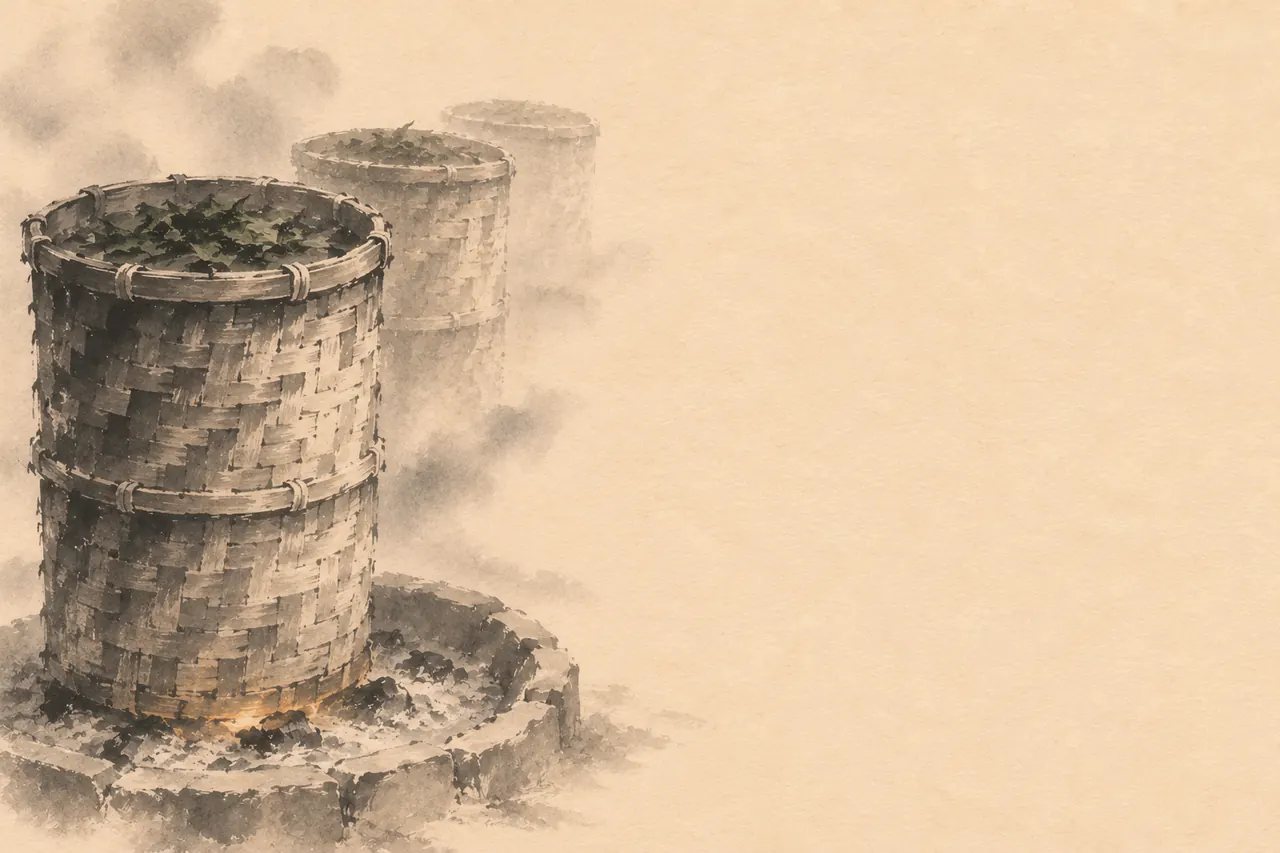
Charcoal is lit in a roasting pit and then covered with a layer of ash, which evens out and softens the heat. Tea is spread in tall woven bamboo baskets set over the pit. The roaster adjusts the heat by changing the ash, checks the tea by smell and touch, and turns it by hand. In the traditional method the long, gentle final roast (炖火, dun huo) is described at around 85 °C for about seven hours, and a tea may be roasted again after resting. Freshly roasted tea is usually left to rest for weeks or months so the "fire" settles before it is drunk.
How does electric roasting differ?
Electric roasters hold a set temperature with a thermostat and timer. They are cleaner, need less labour and give repeatable results across large batches, which is why many producers now use them for some or all of their tea.
| Charcoal roasting 炭焙 | Electric roasting 电焙 | |
|---|---|---|
| Heat | Radiant heat from charcoal under ash | Electric element, often with a fan |
| Control | By hand: ash depth, basket position, turning | Thermostat and timer |
| Time and labour | Slow, labour-intensive; someone tends the fire | Quicker; little supervision |
| Consistency | Depends on the roaster's skill | Easy to repeat at scale |
| Heritage | Part of the traditional technique on China's national heritage list | A modern method |
| Often described as giving | A deeper, rounder roast that integrates well over time | A cleaner, more even roast |
Is charcoal-roasted tea always better?
Not automatically. A careless charcoal roast can taste smoky or burnt, and a skilled electric roast can be very good. Charcoal gives a skilled roaster more ways to shape the tea, and many drinkers prefer the result, but the leaf and the roaster matter more than the heat source alone.
How can I tell how a tea was roasted?
Ask the producer. Taste alone is not a reliable test. A producer who roasts over charcoal will usually be glad to tell you how, and may have photographs of the roasting room.
At Kings Tea. We roast our Wuyi rock tea over charcoal in bamboo baskets, under chief tea maker Liu Dexi, a recognised inheritor of the Wuyi rock tea (Da Hong Pao) making technique. See our roasting room.