What is Wuyi rock tea (yancha)?
Wuyi rock tea (武夷岩茶, wuyi yancha) is a partly oxidised, roasted oolong tea from the Wuyi Mountains in Fujian province, China. Its name is protected: under China's national standard GB/T 18745-2006 it is a geographical-indication product of Wuyishan. Its making technique has been on China's national list of intangible cultural heritage since 2006.
Last updated
Why is it called "rock" tea?
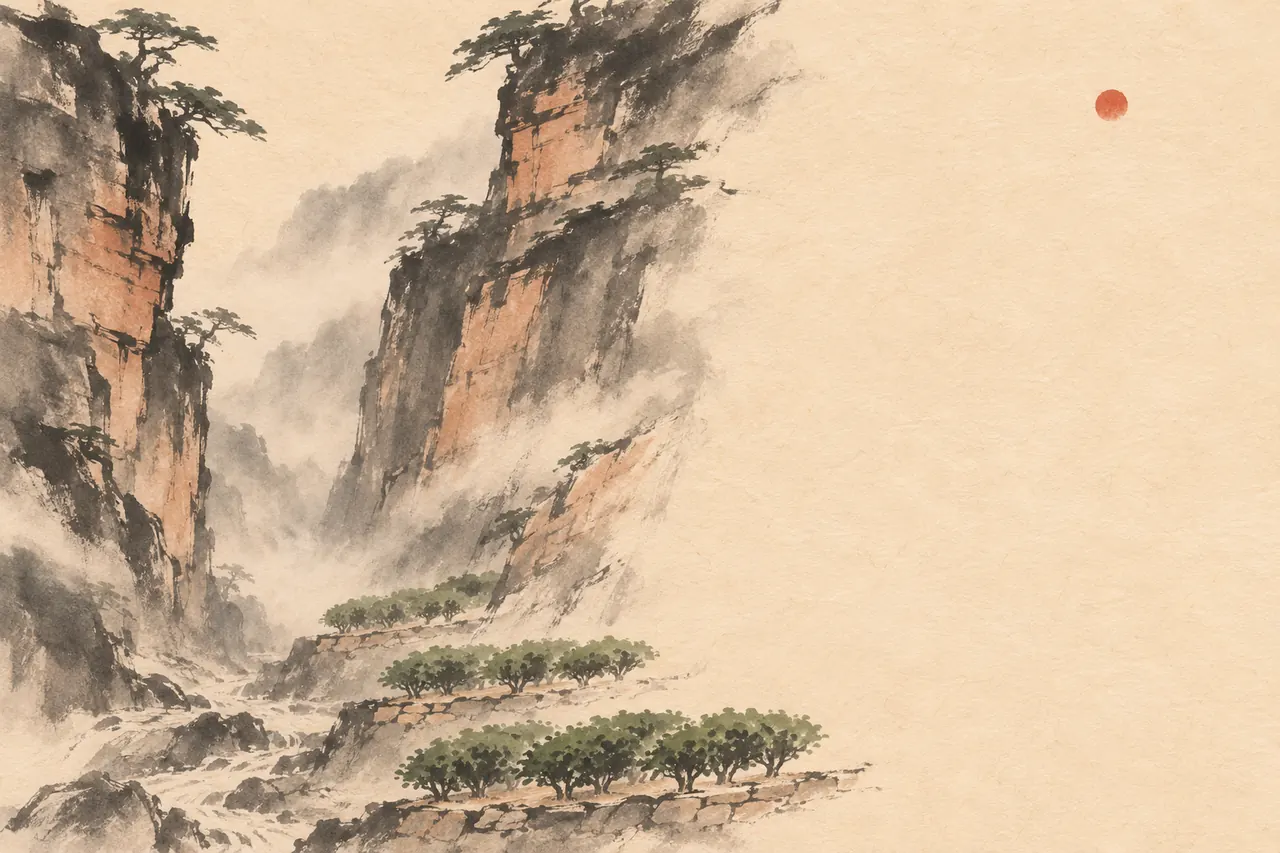
The Wuyi Mountains are red sandstone: steep cliffs, narrow gullies and thin, stony soil. Tea bushes grow on terraces and gully floors between the rocks, and the minerals, shade and drainage of these spots are thought to give the tea its character. Tea drinkers call the resulting depth yan yun (岩韵), "rock rhyme".
Where does it come from?
Only from Wuyishan, a county-level city in northern Fujian. GB/T 18745-2006 sets out the protected area, the cultivars and the method. The mountains themselves were inscribed by UNESCO as a World Heritage site in 1999, for both their culture and their nature.
How is it made?
The technique has six main stages. The judgement at each one is what the heritage listing protects.
- Withering (晒青): fresh leaf softens in sun and shade.
- Shaking and resting (做青): repeated tossing bruises the leaf edges, which oxidise slowly over many hours.
- Firing (炒青): high heat stops oxidation.
- Rolling (揉捻): the leaf is twisted into long strips.
- Roasting (焙火): traditionally over charcoal, low and slow, sometimes more than once.
- Sorting and tasting (拣剔、审评): stems and broken leaf are removed; batches are cupped and graded.
Roasting is what sets Wuyi rock tea apart from many other oolongs. Charcoal vs electric roasting
Which teas are Wuyi rock teas?
| Name | Chinese | What it is |
|---|---|---|
| Da Hong Pao | 大红袍 | The classic name; today usually a blend of Wuyi cultivars |
| Rou Gui | 肉桂 | Single cultivar; spicy, assertive aroma |
| Shui Xian | 水仙 | Single cultivar; large leaf, smooth and mellow |
| Tie Luo Han, Bai Ji Guan, Shui Jin Gui | 铁罗汉、白鸡冠、水金龟 | Traditional "famous bush" cultivars, made in smaller amounts |
More on the three main names: Rou Gui vs Shui Xian vs Da Hong Pao.
Is Wuyi rock tea recognised as heritage?
Yes, twice over. The Wuyi rock tea (Da Hong Pao) making technique was named to China's first national list of intangible cultural heritage in 2006 (item VIII-63). In 2022 UNESCO inscribed "Traditional tea processing techniques and associated social practices in China" on its Representative List; the Wuyi rock tea technique is one of the national items included. Cities and provinces also name individual tea makers as recognised inheritors of the technique.
How does it differ from other oolongs?
Oolong covers a wide range. Many Taiwanese high-mountain oolongs and modern green-style Tieguanyin are lightly oxidised and lightly roasted, with fresh, floral flavours. Wuyi rock tea is usually more oxidised and more roasted, giving a darker leaf, an amber to orange liquor and deeper, toasty, mineral flavours that last through many infusions.
How can I tell where a rock tea really comes from?
- Look for the producer's name and address in Wuyishan, not only a brand.
- Ask whether the seller grew and made the tea, or bought it.
- Ask for documents in the producer's name: organic certificates, test reports, competition records.
About us. Kings Tea (Qingshenge) grows and makes Wuyi rock tea at its own gardens and factory in Huangbai Village, Wuyishan, and roasts it over charcoal. See where our tea comes from.